Vedas Foundation of Vedic Religion

|
|
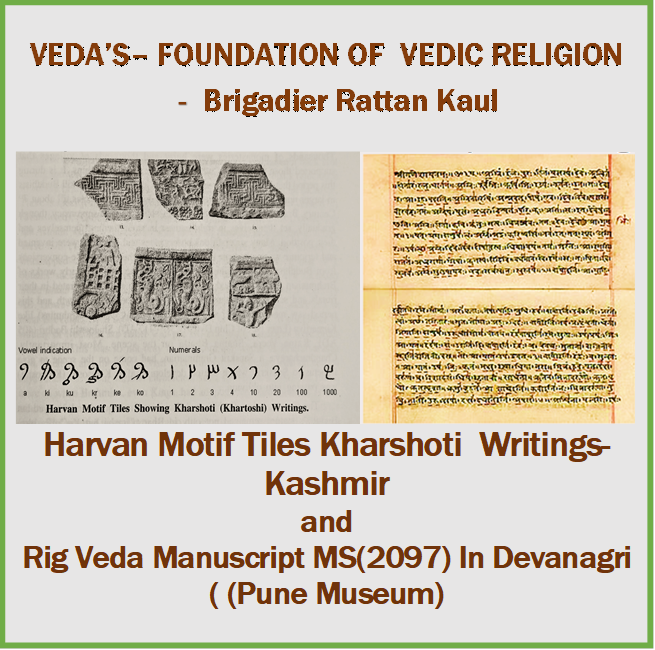
| Veda’s were composed by Rishi’s, not only known ones, but many who also lived in the areas around Saraswati Ashrams. These Ashrams, spread in vast area of North-Western India and got the name after River Saraswati, which is frequently mentioned in the Veda’s. Rig Vedic verses were composed over centuries and in the process of journey of Shruti and Smriti, many Hymn’s were either lost, forgotten or fresh ones added, over the centuries.Veda verses started being composed around +- 1800-1600 BC, coded around 600+- BC. and finally in writing around 500 BC in Kharshoti Script. Kharshoti (Khartoshi) was then prevalent in northern parts of Bharatvarasha; written from right to left, attributed to
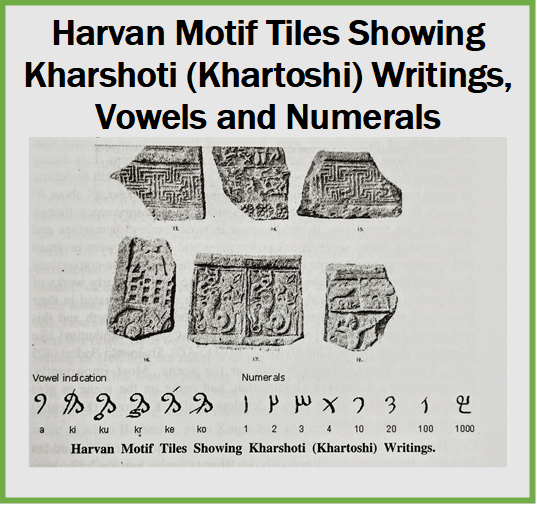 later Aryans.Brahmi came thereafter followed by Pali, Gupta Lipi and Devnagri in 6th Century AD. Around 500BC - 300AD Kharshoti script was prevalent script in Kasmira, motif tiles, writin gs on stones have been excavated at Harvan.
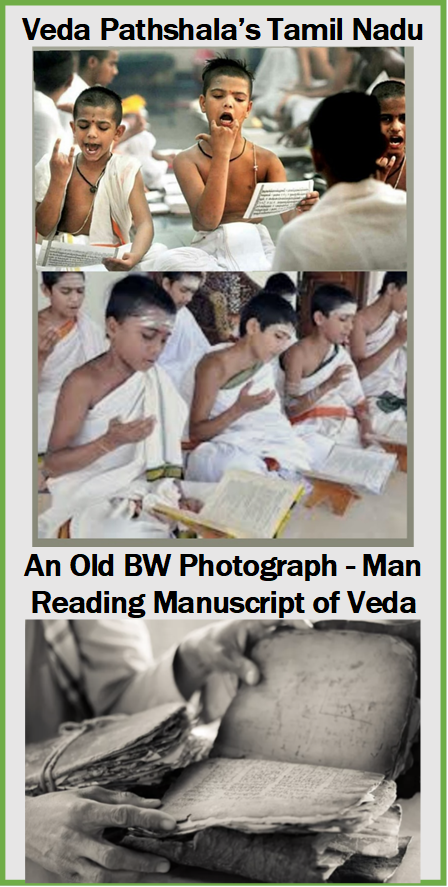
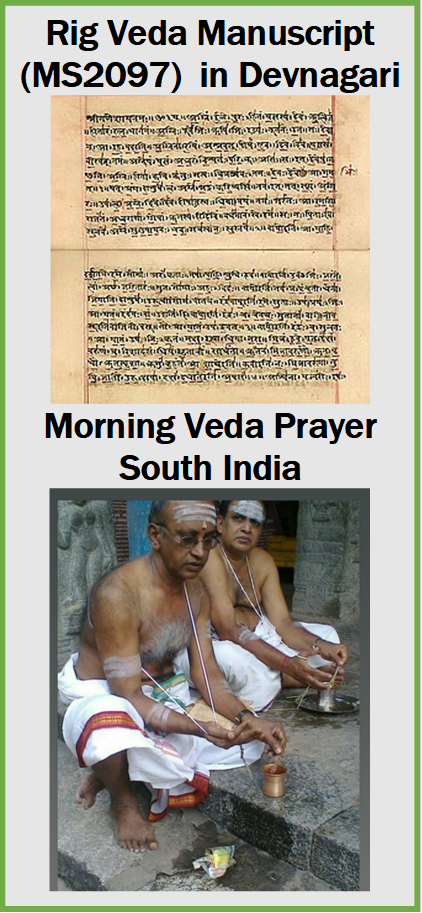
Veda’s were ‘eventually’ written in Sanskrit, at the end of third century BC, after Sanskrit Grammar had been formulated by Panini. A HOD Department of History of a University, rang me up, questioning my assertion of Veda’s scripted first in Kharshoti and asked authority. During this period, it was put up as question in Lok Sabha and confirmed by the Minister of Education. I repeated the same to her. Rig Veda talks about 33 Vedic Gods, 3 groups of 11 each, groups being Air, Earth and Heaven (Three divisions of Universe). Indira is invoked in about one-fourth of RV Verses; protector, helper and friend. None of the Trinty Gods are Vedic Gods. There is no doubt about the source of composition of Veda’s, but a segment attributes these to mouth of God on creation of Universe. Strangely, for explanation they convert existed subjects to natural creation. Also few days back I was confronted “that Kasmira was the source of Vedas” and Kasmira Version of Yajur Veda, claimed to be longest. Of Kasmira there is just a single mention, Vitasta River in Rig Veda. “Favour ye this my lord, O Ganga, Yamuna, O Satudri (Satluj), Parusni and Saraswati: With Asikni, Vitasta (Jhelum, Wyeth), O Marudvrdha, O Arjikiya with Susoma hear my call (Rig Veda -10- 75- 5).” Aryan settlements had spread Northwest and Eastwards and these rivers, apparently were flowing amidst extended Aryan settlements, giving rough idea of the extent of later Aryan settlements. On a fair estimate, there are 21 branches of Rig Veda, 109 of Yajur Veda, 50 of Atharv Veda and 1000 of Sam Veda (Only 2 are now extant). Rig, Atharv and Yajur Veda’s have similarly been depleted, numerous variants based on areas, geographical locations have been created and some are called by local names of Veda. There were approximately 200 Shakha’s (Branches) of Vedas at one time, including mixed Shakha’s, which had even spread throughout South Asia. Their locations changed, as communities of Brahmins of a particular Shakha migrated from or adopted another Shakha. The tradition of recitation of the Vedic texts originated in North India and in the area where the Shakha’s originally arose. All said and done it was rare in Kasmira. |
|
| Some of these are:- Shakala Rig Veda (Karnataka, Kerala, Tamil Nadu and to some extent in Uttar Pradesh); Bashkala Rig Veda; in Kerala; Ashvalayana Rig Veda: Manuscripts have been found in Kasmira and at many other places. Paingi Rig Veda; in parts of Tamil Nadu; Shaunakiya Atharv Veda: Gujarat, Karnataka, Coastal Andhra Pradesh; Mauda Atharv Veda, existed in Kasmira. Yajur Veda. Madhyandina Yajur Veda, Kanva Yajur Veda, Charaka Yajur Veda. Charayaniya Katha Yajur Veda; Existed in Kasmira. oral traditions of this Veda became extinct possibly in 20th Century. A text called ‘Yajur Vedavriksha’ gives the geographical distribution of more than 100 Shakha’s of Yajur Veda around Southern parts of the country there is a form of Black Yajur Veda. Sam Veda. Kauthuma, Ranayaniya Sam Veda and Jaiminiya/Talavakara Sam Veda. Gautama Sam Veda is said to have been prevalent in Tamil Nadu till 17th century AD. Bhallavi Sam Veda is said to have been prevalent Karnataka and parts of North India including Kasmira. There are three more known Shakha’s of Yajur Veda. Kathaka Yajur Veda; found in Central and Eastern Punjab, Himachal Pradesh, possibly West Punjab and NWFP. In later times, it got restricted to Kasmira, where all their extant manuscripts have been unearthed. The aim of giving these Shakha’s of Veda’s is to bring home that variation in these scriptures exist, from region to another, mainly incorporating local tradition, deities and requirements. Around 2005 in my article on Veda’s in Koshur Samachar, I had mentioned of Laugaksh Veda of Kasmira; a local extension of Yajur Veda which has increased in contents. Apart from various mantra’s, it enumerates rituals and mantra’s associated with birth onwards, both for boys and girls, which are followed even to this day. Additions included Rituals and ceremonies of Nilamat, Aryan’s Vaishnavite and Kasmiri Shaivism.Laugaksh Rishi is Gotra head of many Kasmira families ; Bhan, Handoo, Pandit etc.. I was surprised to find Hymn’s ‘Shiv Sankalp’ in one Kasmiri Panchang, attributed to Yajur Veda. Shiv {Shiva} is the centre of veneration in the Hymn: “Yata-Jagrato-duram udeti Devam, Yajur Veda, as composed, does not mention Shiv as one of the Aryan Gods. Whether it is the Yajur Veda of a Kasmira School that has these Hymn’s. Unlikely or the Panchang composers have taken readers for granted for their ignorance. |

|
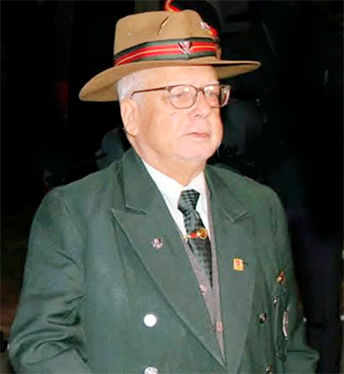 *Brigadier Rattan Kaul War Veteran (1965, 1971 War’s ad many other Military Opeartions/Assignments during his 33 years Service. A Gorkha Soldier to the core, born in Srinagar, he carries Ethos, Values, Culture, Heritage andCustoms of Kasmira.
 Amongst his 6 Published books; three are Kashmir Centeric. History of Kas’mira (2013); Goddess S’arada and Adi Shankaracharya (2023) and KINGDOM OF KASMIRA (KASHMIR). His book on War Accounts of his Battalion, of which he was part have been published in 2022; Repository of Valour . The book has been commended by Government of India/Ministry of External Affairs, SELECTED and issued to various |
|
|