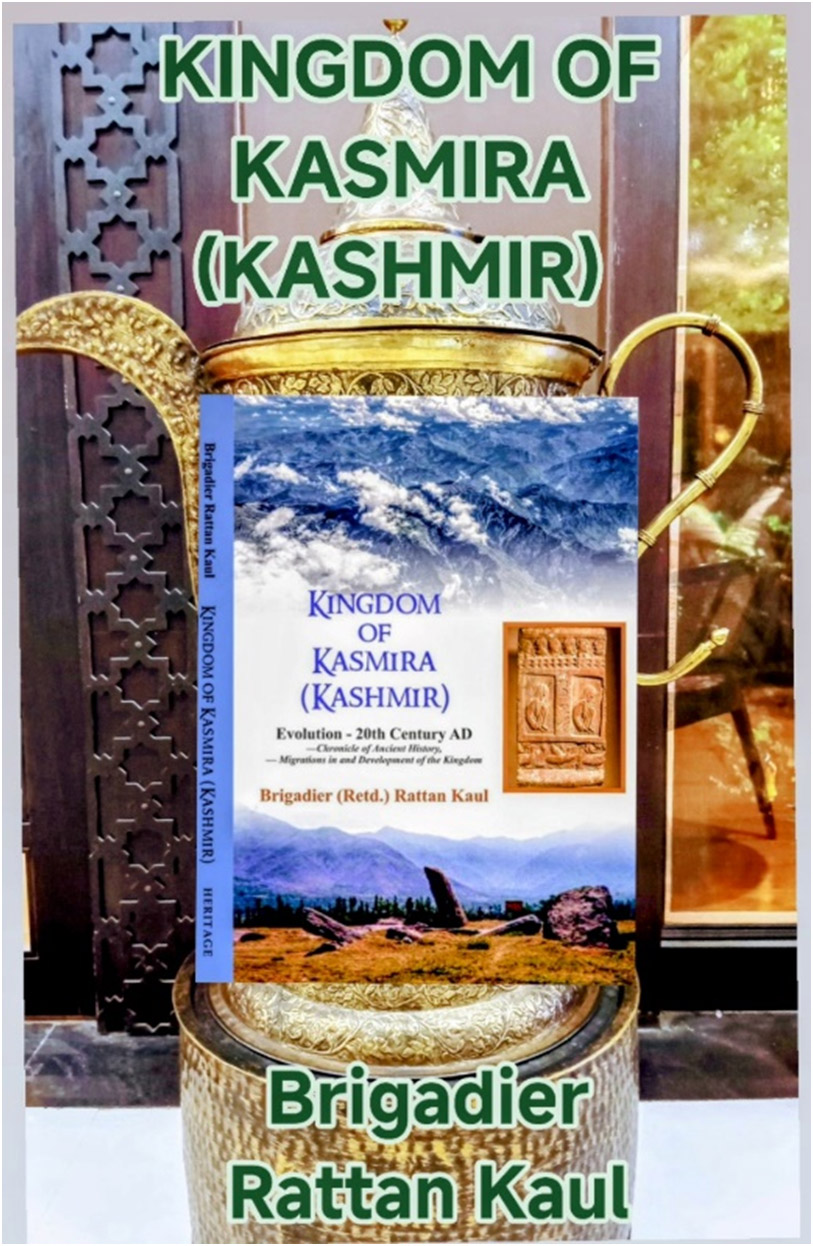
KINGDOM OF KASMIRA

|

|
| KINGDOM OF KASMIRA(KASHMIR) By Brigadier (Retd) Rattan Kaul You will never do anything in this world without courage. It is the greatest quality of the mind next to honor- Aristotle 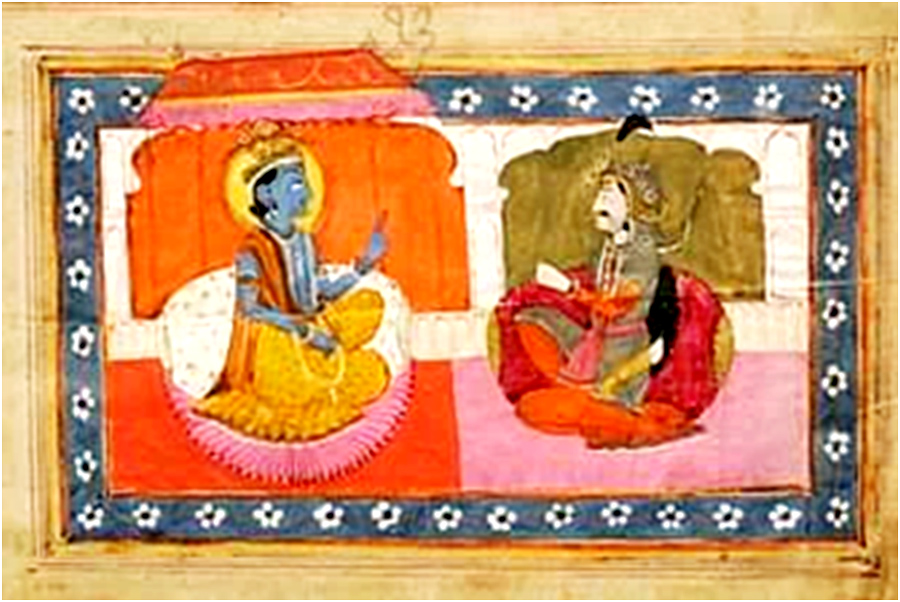
Raja Parikshit in front of Vishnu
|
| Born in Kasmira (Kashmir), I moved out early as a teenager to join Army.I had left Kasmira, not for good, but carried Ethos, Values, Culture and Heritage, as my proud possession, from my roots. I carried these to my Army life and together with my Gorkha colleagues, my take, strange then to me, was amalgam of soldiering and what I carried from my roots. There was continuous sub-conscious interaction with my land of birth, plentiful of inclination, reading books, manuscripts, scriptures, and chronicles. For the last twenty years I tried my best to strike a balance between the two and know more and more about Kasmira {Kashmir}. Born in Kasmira (Kashmir), these words of Kalidasa’s used to come often to my mind; “The place is more beautiful than the heaven and is the benefactor of supreme bliss and happiness. It seems to me that I am taking a bath in the lake of nectar here.” My memories of my growing years remained deep in my mind, though dormant during military service. There were moments, fewer though, when I used to look back to my growing years. Earlier my two books, Kasmira Centric, had been published and welcomed by readers all over. My 6th Book, which I embarked upon, is KINGDOM OF KASMIRA (KASHMIR). During my normal studies with interest on the Historical aspects of Kasmira, I found bits and pieces of unconnected accounts, even laced with fiction cum imaginary accounts. There were yawning gaps in Chronology and even then, these were in isolation of the happening from outside, which effected Kasmira. Unlike any other place in world, Kasmira has a unique standing, irrespective of its Geographical existence and cannot be talked about in isolation.
Perched as Crown of India, it is more than that; from all four sides, even in ancient times, it was centre point of four civilisations; Chinese in East, Central Asia in North, in West BC era Civilisations and in South, Indian Peninsula. 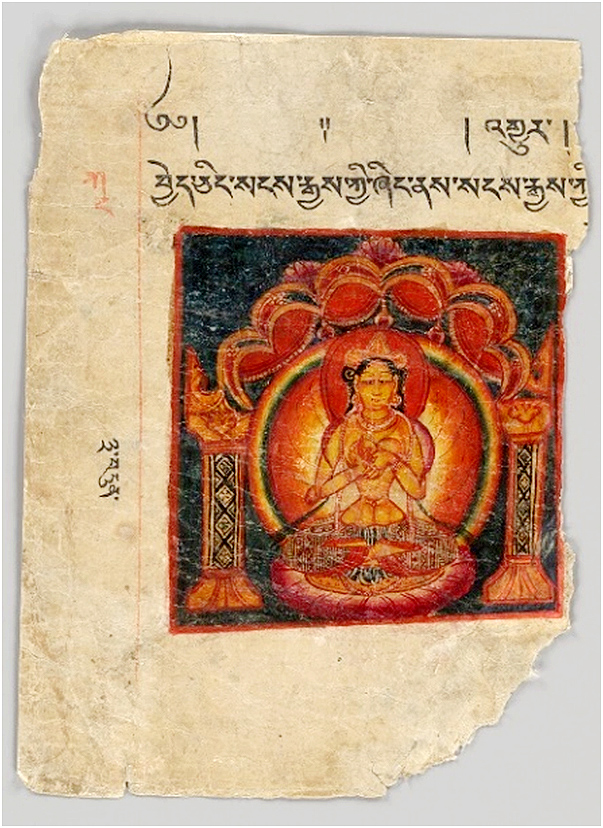
Hand Painted Page from Old Sharada Manuscript Pre BC era King Asoka, a Gandhara scion, begot a son after worship and this King build Srinagara, also called Girinagri and referred to as Puranadishtan. Unfortunately, translators, novo writers etc treat him as Ashoka of Mauryan Dynasty. Mauryan’s ruled almost whole of Northwestern India, including Kasmira, but do not find mention in Chronology of Kasmira. But somehow attributed to have fifth son Jaluka. To give veracity to this vague claim, many stories have been created so that the stories woven around Ashoka so that redacted accounts are taken as authentic. The periods after Gonnada’s and Asoka till Kushan’s, had left out many important phases of the Kingdom, more so as to how the Buddhism made inroads in otherwise Vedic religious society. Happily, events of these important centuries in the history of the Kingdom have been filled with authentic details. This blank period was that of the rule of Indo-Greeks and Saka’s(Indo Scythian’s), who left lasting impression not only in Northwestern India but also in Kasmira. Kushans came later on the radar of Indian Subcontinent but in Kasmira initial Kushan Emperors just left traces of their rule, till descendants of Kanishka were recognised in Kasmira Chronicles, as the rulers. Surprisingly historians, writers etc failed to account for the rule of other Kanishka’s, who ruled India as well as Kasmira. This ignorance is primarily responsible for blaming Kalhan in wrongly sequencing the three Kushan Emperors relevant to Kasmira. Kalhan absolutely is correct, as knowledgeable historians failed in going deep into the dynasty and Kushan Emperors, who ruled many parts of India, including Kasmira. Kalhan’s sequence of Kushan Kings in Rajatarangini is absolutely correct; this Kanishka is Grandson of Kanishka I. Much is talked about so called 4th Buddhist Council in Kasmira, under Kushan King Kanishka (Who). It was a Synod, not a Council, of dissenters and not recognized as Fourth Buddhist Council, where the Sarvistvada Sect of Buddhism was founded, under Kanishka (II). This synod traces facts as to how an orthodox Buddhist Kasmiri Branch School emerged during the Synod but could not carry themselves further. The fact also is that it was Katyaniputra, a Buddhist Scholar, who is deemed as the founder of Sarvastivada Branch of Buddhism. The detailed rule after Kushans by Kidarite’s and Huns has been clearly covered. Many important Kidarite rulers names were found to be changed in Kasmira chronicles. No wonder it seems Ksmira chroniclers had a system to name the rulers of a particular dynasty by nicknames etc, though most of them had proper names. Apparently, the original names were too much to be recorded. In case of Hun’s the mix up was so much that Historians called later Hun descendants who ruled Kasmira as Kasmira Branch of Huns. It was Hun King Toramana, father of Mihirakula, who constructed the Varaha Temple at Varahakshetra, which gave the name Varhakshetra to present day Varmul (Baramulla).. Surprisingly in Rajatarangini Vasukula is chronicled as the father of Mihirakula instead of Toramana. Kalhan seems to have been fond of giving names to rulers of known dynasties, which were at variance with their actual names. Examples are many; Gonanda I was from Gonand dynasty and got to be mentioned as Gonanda I and his Grandson Gonanda II and the dynasty as Goannada’s. Somewhat intriguing is as to why his son was named Damodara. Another glaring example; in historical accounts there were three Pravarsena’s as rulers of Kasmira. Amusingly writers and even Jammu and Kashmir Government has mistaken these Pravarsena’s with Vakataka Ruling Dynasty of Western India, who ruled full 200 years before Pravarsena’s of Kasmira. Kings like Meghvahana and his queens, specially Amritprabha, daughter of Varman King of East India (Kamrup), leaves with a glorifying account of the King and his Queen’s. The role of Queens of Kasmira have a mixed bag, ironically many faltered in their duties, first as regents and later as rulers. However, Yasoavati, wife of King Damodara, first as Queen and then as Regent of her son Gonanda II was epitome of a worthy Queen. But what interests most is Queen Suryamati, wife of King Ananta, who became famous for listening to Kathasaritsagara stories from Scholar Somadeva. The penance of Suryamati on the cremation of her husband, King Ananta, the account of her performing Sati touches heart. Dida, also called Dida Charanhina, as regent and queen, though an able administer, failed in morality and her ambition for power, where she did not even spare her son and Grandchildren. Sugandha too has mixed bag of protecting her infant son, as Regent after death of her husband and then as a Queen how she was corned and put to death. 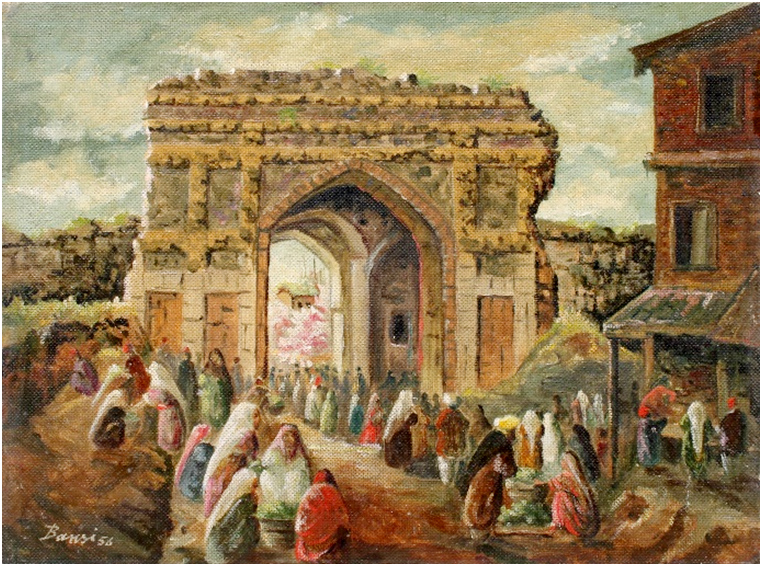
Kaeth Darwaza Painting by Late Bansi Parimu (1956) Something unknown is as to how Mongol Khanate of Khagan Ogedi had Kasmira under it, during mid 13th Century and even two Kasmiri Kings were murdered by Mongol though their Darugachi(Administrative Governor) and later also by Zulchu. During this period the role of Lhara (Lar) Damras (war Lord) started from their Malla Chandra of Chanda Clan of Rajput Katoch Dynasty of Trigarta (Kangra) came to be the dominant Damra in the Kingdom and how their ancestors immigrated from to be the dominating role of Lhara (Lar Damras), right up to the last three members of the clan; one was killed, one converted to Islam and was rewarded and third made advent of Islam easy. It also analyses as to which class of Brahmins, staunch in their religious beliefs, were in fore front to be converted, while other sect remained steadfast to their religion. It was the later segment which carried the Brahminism and people, through five centuries of Muslim rule and their faith remained in-spite of tyranny, forced conversions etc. Kasmira produced two specific mystics; both in 14/15 the Century; Lalita (Lal Ded) and Sheikh Noor-u Din (Nund Reush). Both were Kasmiri’s by birth and both had convergence of thoughts which made the base for Rishi-Sufism. Lalita- Lalla in her role as Lali, Lalle and later as we called her Lal Ded through her Vakh’s and Vachun’s, gave out her inner voice. Simple, but meaningful to a common man of that era. Her Vakh’s were carried by Shruti -Smriti, but after her, many created sayings were attributed as her Vakh’s. These could be found out as fake. as they failed to convey her spiritual and inner conscious words and feelings which Lalla Vakh’s conveyed. These meaningless Vakh’s, could be flagged immediately, by those who had understood her authentic Vakh’s. As Lalla aged she was fondly called Lal Ded (Lalla the Grandmother), she died as an ardent worshipper of Shiva, mystic as she was, conveyed her advice to Bhatta’s and even converters, few at that time, who also revered her. Muslims called her Lalla Arifa (Believer), much after her death, not that she had converted, but the fact that her Vakh’s touched the inner conscience of all Kasmiri’s, as she believed in certain values, and as saner voice. She merged with her creator without leaving a trace; no temple no samadhi, a Masjid is out of question. It is a privilege to interpret her much misinterpreted Vakh’s, the birth of Sufism and Shrukh’s of Sheikh Noor-u-din. The account of love forlorn Habba Khatun and a poetic product of Afghan Rule; Arnimal itself takes away the mind from harsh reality of tyrant Afghan Subedars during the period. With tongue in cheek, except possibly King Gonanda II there was no Kasmiri King of the Kingdom, some sort of exception being Laxman Deva, son of a Brahmin family, who was adopted by then King Rajadeva and succeeded him. However, though a Kshatriya King, he could not forget his Brahminical outlook and finally was murdered. His Wife, Queen Ahlia, added something to the history of Kasmira; constructed a Ahila Muth which even now is recognized as Gund Ahlamar. That is how the Vale of Gods surrounded by massive mountains, a lake developed into a Kingdom; and the book KINGDOM OF KASMIRA (KASHMIR) emerged in 2025 from the erstwhile vast lake of Kasmira, also fondly called Vale of Gods.. |
|
|
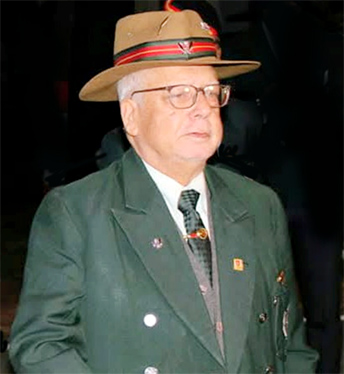 *Brigadier Rattan Kaul A soldier, who participated in 1965, 1971 War and many important operational assignments and seriously injured in Battle during 1971 War. Gifted with Values, Ethos, Culture and Heritage of Kasmira, he has 2 out of his 5 Books, which are Kasmira Centric and acclaimed by readers. The 6th one KINGDOM OF KASMIRA(KASHMIR) is his two decade researched book, published recently and at the start of its journey termed as Book Of The Year. Available on Line Amazon India, Flipkart, Amazon.com (US,UK etc)
 |
|
|