The Spring Faraway

|
| BOOKS & PUBLICATIONS |
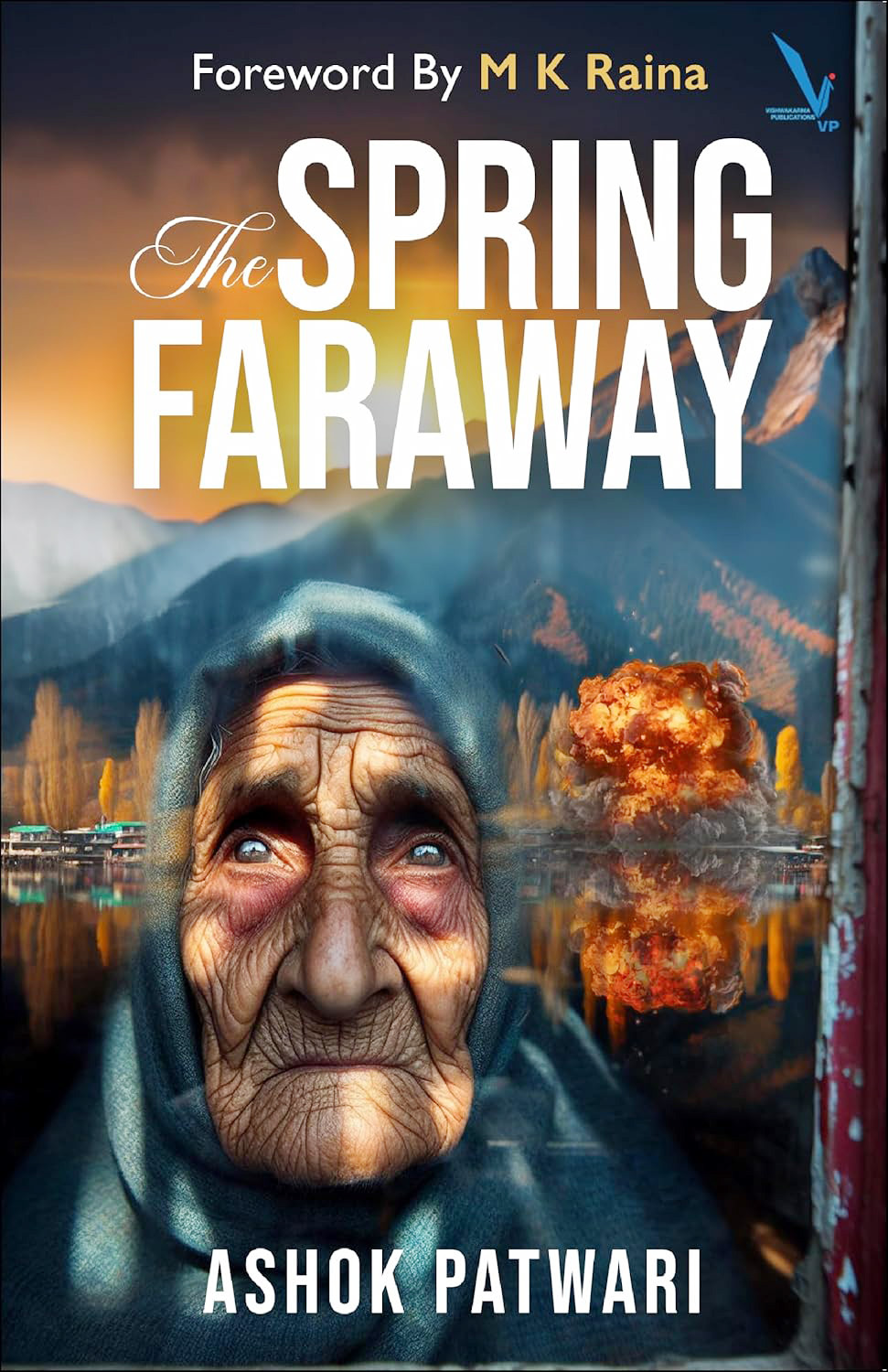
 The Spring Faraway
 Art and Wisdom of Kashmir by Ashok Patwari
|
|
|
|
| Publisher : Vishwakarma Publications Publication date : April 19, 2025 Language : English Print length : 272 pages ISBN-10 : 9349001101 ISBN-13 : 978-9349001107 Item Weight : 14.7 ounces Dimensions : 5.5 x 0.68 x 8.5 inches The book is available on Amazon India, USA, Canada, Australia, UK and some other European countries. Link for Amazon USA: https://a.co/d/8CvwlMN |
|
|
| Synopsis |
|
|
| "The Spring Faraway" unfurls as a sweeping multi-generational saga, offering an intimate glimpse into the lives of two Kashmiri families: the Pandit Dhars and the Muslim Dars. Their paths, entwined from 1947 onward, are profoundly shaped by Kashmir's ancient history and vibrant cultural tapestry. This poignant novel traces their socio-religious odyssey, set against the heart-wrenching backdrop of the forced exodus and genocide of Kashmiri Pandits in 1990. It explores the deep anguish of displacement, the brutal aftermath of militancy, and the enduring battle for Kashmiri Pandits to reconcile with their past in Kashmir, as they tirelessly nurture the unwavering hope for renewed peace and the return of spring to their beloved motherland – Maej Kashir.. |
|
|
| Review by Kanwal Krishan Lidhoo |
|
|
| At a time when postmodernism dominates the cultural landscape and humanity faces an existential crisis, it feels both necessary and difficult to engage with yet another work on Kashmir that centers on the now-familiar theme of exodus. The Spring Faraway is a thoughtful addition to the limited but significant literature on Kashmir. It offers an honest portrayal of a land scarred by conflict, where loss seems endless and healing remains distant. It is a story of broken faith, trust, and innocence. Ashok Patwari, the author, remains true to his creative purpose. He avoids political correctness and speaks with rare clarity-neither aligning with the right nor the left. The novel traces the threads of historical upheaval in Kashmir, pointing to the enduring consequences of the Two-Nation Theory and its religious divide. At its core, the Kashmir conflict is not just a political crisis but a deeply human tragedy, especially for the Kashmiri Pandit community, whose contributions are woven into the valley’s cultural fabric. It is a loss of values 1 and a dismantling of a shared heritage that once transcended identities. Through characters like Surinder and Roshan, the novel explores the internal contradictions within the Pandit community—its hesitations, misjudgments, and misplaced trust in the Indian state’s protection. The character of Roshan, in particular, reflects a kind of naïve optimism that mirrors broader systemic failures in both Kashmir and India. The Dhars, Dars, Prithvi Naths, Aziz Joos, Ghulam Mohamads, Razdans, Suris, and others emerge as fading figures—reduced to fragments of memory, waiting to be rediscovered by future generations, long after the urgency of these events has passed. As with any society that gives way to fundamentalism, Kashmir has seen the suppression of its diverse identities and the silencing of voices once central to its character. These losses are not easily reversed. The novel also suggests that Kashmiri Muslims may one day reckon with the consequences of turning toward extremism. The violence that followed feels foreign to their cultural instincts, and the cost of this betrayal may prove long-lasting. Unlike many works that hesitate to confront uncomfortable truths, this novel presents a clear and grounded view of what happened—and what was lost. Patwari writes not just as an observer but as someone who has lived through the events he describes. The characters of Fauzia and Azma give voice to the suffering of women- quiet, enduring, and often overlooked. Their experiences speak to a deeper vulnerability in the valley, where the loss of dignity and security is shared across communities and experiences. While The Spring Faraway moves at a slower pace and avoids dramatic turns, it still resonates. Compared to Leon Uris’s Exodus, which holds out the hope of a new beginning, Patwari’s work offers a quieter, more sobering view of history—one where resolution remains distant, and memory itself becomes a form of resistance. Having researched comprehensively on the "Literature in Exile" and presented a paper in this connection, The Spring Faraway belongs to a different category altogether. It's treatment of a historical upheaval combines the ages, the nuances of its characters which require a thorough assessment and literary interpretations. It certainly is not the run-of-the-mill stuff, unlike most of the literature in exile. The book has even shades of Arvind Gigoo's ‘Ugly Kashmir’, which the author must have certainly arrived at independently. * Shri Kanwal Krishan Lidhoo is a noted Broadcaster, Author, and the Founding Director of Kashmir Rechords Foundation. |
|
|
| Review byProf. Virender Rawal |
|
|
| THE SPRING FARAWAY by Dr. Ashok Patwari is not just a book—it is a profound journey, a meticulously documented travelogue that speaks not only to those who have endured the harrowing exodus but also to those who can only grasp its painful reality through its pages. To be completely honest, I have never before written a review of any book, nor have I ever expressed my thoughts on one. The primary reason for this has been my hesitation in articulating my reflections in writing. However, after reading this book, memories of those distressing times came flooding back, compelling me to put pen to paper and express my sentiments. Dr. Ashok Patwari’s "The SPRING Faraway" is neither fiction nor a figment of imagination. It is a stark and unfiltered reflection of our bitter past. The way the author has painstakingly brought these realities to the common reader is both commendable and unforgettable. Every event in this book is structured into chapters that grip the reader and pull them deeper into the narrative. Whether it is the October 31, 2020, tragedy in Sopore, Kashmir, involving Prithvi Nath and Parmeshwari, or the September 1989 discussions in Delhi that shook the minds of Roshan and Dr. Surinder, every incident is presented with striking authenticity. Be it the horrifying slogans of "Pakistan Zindabad" and “hum kya chahtey Nizam-e- Mustafa" that echoed through Srinagar in 1990, or the miserable plight of displaced migrants living in Purkhoo Camp, the book lays bare the tragic experiences not just of the author or myself but of countless others who lived through those times. That is precisely why once you start reading this book, you cannot put it down. It is a fact that with time, we have tried to bury these haunting memories. Yet, somewhere deep within, the scars remain permanently etched in our minds. Our younger generations, too, have become aware of these grim realities—be it through literature or films. I firmly believe that it is our duty to ensure that every incident we endured reaches future generations as a testament to history. This book is an essential link in that mission. In addition to chronicling Kashmir’s past, the book also delves into the history of Anaya Kashmir in Chapter 5, demonstrating the author’s integrity and unbiased approach in narrating these events. The resilience of Prithvi Nath, who refused to flee Sopore despite the looming threat of militancy, and Haji Ghulam Mohammad’s advice to him to stay, reflects the deep-rooted communal harmony that once existed. The author successfully portrays the bitter truth of how Kashmir’s new generation harbours resentment against Kashmiri Pandits, a reality many often overlook. The book also rekindles the painful memories of the Kashmiri Pandits’ exodus during the Tribal Raid of 1947 and the subsequent massacres, as well as the psychological divide between villagers and city dwellers. For this, Dr. Patwari deserves immense appreciation. One of the chapters beautifully captures the daily lives of several local families, particularly the moving story of Gula and Azma in Rainawari, which resonates deeply with readers. A poignant moment unfolds in New York, USA, where Abdul Rashid’s son and Haji Ghulam Rasool’s grandson, Muqbil, meets Dr. Vinod Raina—a scene that will remain etched in the reader’s memory. Muqbil’s unwavering love for his grandfather, Haji Ghulam Mohammad, is depicted with heart-wrenching beauty and depth. Yet, despite all this tragedy, the author’s optimism for Kashmir’s future is truly remarkable. With a sense of great responsibility, the author conveys this hopeful perspective through the characters of Muqbil and Dr. Vinod, making it a powerful and complete literary endeavour. In conclusion, I extend my heartfelt congratulations to Dr. Ashok Patwari for this extraordinary book, and I sincerely hope that he continues to write with the same honesty and dedication in the future. |
|
|
| Chapter-1 Sopore, Kashmir, 31 October 2020 -It was past midnight. in this Issue |
|
|
| About the Author |
|
|
 Dr. Ashok Patwari, a pediatrician with a passion for storytelling, grew up in Habba Kadal, Srinagar, and received his early education from S.P. High School, Srinagar. He's a prolific author with 16 books in English, Hindi, and Urdu, and "The Spring Faraway" is his fifth English title. His distinguished career includes roles as Professor of Pediatrics at Lady Hardinge Medical College, New Delhi, and Research Professor of International Health at Boston University School of Public Health. He also dedicated his expertise to the World Health Organization in India and the Philippines. In 2005, his literary achievements were honored with the prestigious Delhi Urdu Academy award. Dr. Patwari currently resides in Houston with his wife, while his daughters serve their communities as an orthodontist in Houston and a pediatrician in Seattle.
 |