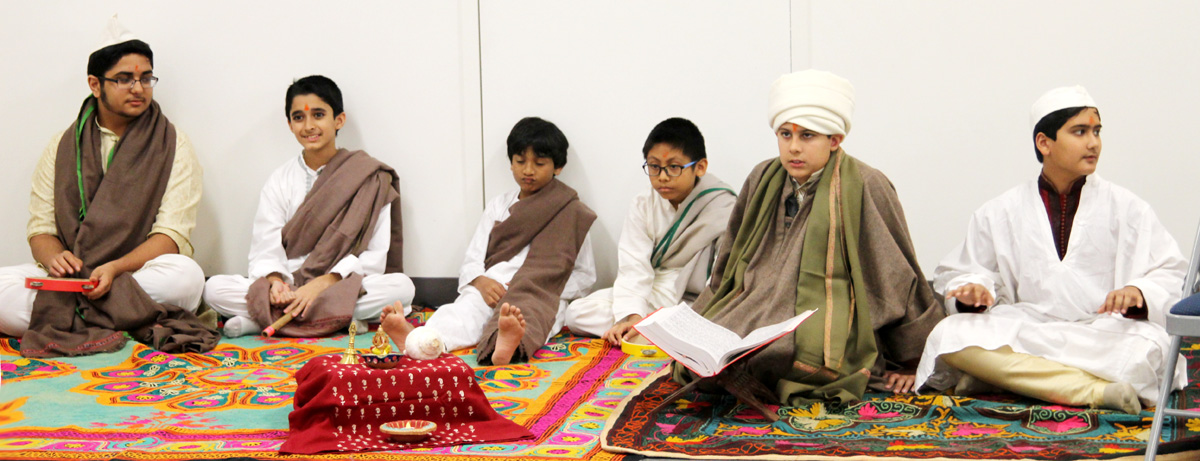
From Scholarship to Symbolism

|

From Scholarship to Symbolism: Has ‘Pandit’ Lost its Root? Veer Krishan Sharma
|
| There is a persistent misconception that the term ‘Kashmiri Pandit’ implies a detachment from the wider Hindu identity. This is both historically inaccurate and spiritually untrue. The word Pandit was never intended as a caste marker or a separatist label—it was, and remains, a designation of responsibility, not privilege. It referred to those who, in ancient Kashmir, were entrusted with the sacred duty of preserving Dharma (righteous order), Shāstra (scriptural knowledge), and Ritual through rigorous scholarship and spiritual discipline. It is a name whispered across time, echoing from snow-covered shrines, from the fires of Homa (sacred fire offering), from the pages of Shāradā manuscripts smudged by exiled fingers. Just as the Namboodiri Pandits in Kerala or Gaud Brahmins in the North have served as custodians of Sanātana wisdom, the Kashmiri Pandits were—and, in many ways, still are—a living thread in that eternal Vedic fabric. Yet in the turbulence of exile, modernity, and cultural rupture, one is compelled to ask: Has the essence of Pandit survived? Or has it gradually faded—from a calling of scholarship to a mere symbol of memory? In modern discourse, the term ‘Kashmiri Hindu’ is often used interchangeably with ‘Kashmiri Pandit.’ But this casual substitution overlooks the deeper meaning and historic weight of the word Pandit. A Kashmiri Pandit is not merely a Hindu from Kashmir—he is a descendant of a lineage steeped in Vedic wisdom, Śaiva philosophy, and ritual authority.The identity of the Kashmiri Pandit is not simply a matter of regional pride. It is a spiritual inheritance forged in the Himalayan stillness, shaped by centuries of scholarship, and sanctified by sacrifice. To call oneself a Pandit is not to claim superiority—it is to accept a silent vow: that one shall not forget. To understand the depth of this heritage, one must look to the towering figures of Kashmiri Śaivā and Sanskritic thought: 1. Abhinavagupta (c. 950–1020 CE) – A polymath, mystic, and philosopher of Kashmir Śaivism, whose work Tantraloka (the light of tantra) is considered a crown jewel of Indian metaphysics. – Revered even beyond Kashmir, he is often called “The Last of the Universal Pandits.” 2. Kalhana (12th century) – Author of Rājatarangini, the world’s first historical chronicle in verse. – His style blends Sanskrit poetry and historiography—a rare combination that reflects deep scholarly training. 3. Jonaraja and Srivara – Successors of Kalhana, they continued the tradition of documenting Kashmir’s cultural and political history in learned Sanskrit. 4. Pandit Bhaskara (10th century) – A great grammarian and ritualist whose works were foundational in preserving Śaiva rituals and commentaries. 5. Pandit Anandavardhana – The father of Dhvani theory (theory of poetic suggestion) in Sanskrit aesthetics, which revolutionized the understanding of poetic nuance (vyañjanā). In modern times, many Kashmiri Pandits are disconnected from the very learning that once defined their title. They are engineers, doctors, professors—yet very few are students of the Vedas or Tantras (sacred scriptures of spiritual and ritual science). Kashmiri Pandits were the learned custodians—not just by intellect but by inner refinement (samskāra—cultured impressions shaped by rituals and education). Their lives were ritualised not as mere performance, but as profound alignment. From Kuldevta Pūjā (worship of the family deity) to Śaivācārya philosophy, they carried within them the encoded essence of Trika (the triad of Shiva, Shakti, and soul), Spanda (divine pulsation or vibration), and Pratyabhijñā (recognition of the Self as Shiva)—philosophies which today global academia studies, but which once resonated in Kashmiri homes like lullabies. The Nīlamata Purāṇa, a foundational spiritual text of Kashmir, clearly designates ritual life for the land’s people, tying every festival, every offering, every river and mountain to divine memory. Who preserved these memories? The very ancestors of today’s Kashmiri Pandit youth. Every forgotten custom is not just a lost ritual—it is a broken thread in the fabric of identity. Since the exodus of 1990, the displaced Kashmiri Pandit community has faced the double trauma of geographic separation and cultural dilution. The rise of intermarriage, urban assimilation, and loss of linguistic heritage (Kashmiri and Shāradā) have accelerated this dilution. For example, a child born to a Kashmiri Pandit father and a non-Kashmiri mother may grow up unaware of Kuldevta worship, Herath rituals, or even their Gotra (ancestral lineage)—unless carefully preserved. In such cases, calling them ‘Hindu’ may be accurate, but calling them ‘Pandit’ becomes symbolic at best—and hollow at worst. Being a Pandit is not a status symbol; it is a sacred obligation. It demands a return to learning, Sanskrit, rituals, and language—not for pride, but for preservation. At the same time, the community must evolve—creating cultural institutions, digital gurukuls, and mentorship channels for younger generations. The ideal path is not exclusivity, but authenticity.There is a silence now in those valleys. Not because the Pandits have perished, but because many have forgotten why their voice once mattered. Diaspora brings comfort, but it also brings the slow forgetting of one’s own sacred vocabulary. Children now bear Panditsurnames without knowing their Gotras, their Kuldevtas, or the secret meaning of Herath. Some light oil lamps in March without knowing that it commemorates Shiva’s marriage not just in heaven, but in their own ancestral bloodline. This is not a complaint. This is a lamentation spoken in the tongue of memory. The term Kashmiri Hindu refers to the broader religious identity, which includes all followers of Sanātana Dharma in Kashmir. This term is more inclusive, but also more vague. The word Pandit, however, indicates::
The world around us has blurred the lines of spiritual hierarchy—not to create equality, but to erase excellence. In such times, the Pandit identity has become inconvenient. It is easier to be called ‘Hindu’ and blend in. But in blending in, we do not harmonise—we dissolve. If the word ‘Pandit’ no longer evokes discipline, Vedic command, and Śaiva subtlety, then it becomes a decorative surname, not a living title. Intermarriage, urban migration, loss of the Kashmiri language, and the silence of temples—these are not external tragedies. They are internal surrenders. A community dies not when it is killed, but when it no longer remembers why it should survive. Yet even now, in quiet corners, there are those who light a ghee dīpa (clarified butter lamp) before chanting Rudram—not as ritual, but as invocation; who still whisper Shāradā letters onto worn slates; who still teach their children the meaning of tithi (lunar day), Gotra (ancestral lineage), and varṇa (spiritual order)—not with arrogance, but with reverence. These few are not fanatics. They are torchbearers—flickering flames in exile, holding aloft not identity, but sanskriti (civilizational essence) itself. To be a Kashmiri Pandit today is to be at the edge of extinction—but also at the cusp of rebirth. Not all who carry the name will carry the fire. But a few must. And they must carry it not with pride, but with penance. Kashmiri Pandits trace their lineage to scholars, priests, philosophers, and astrologers who once defined the intellectual and spiritual backbone of Kashmir. They were the custodians of the Shāradā Peeth—one of the most revered seats of learning in ancient India. Names like Abhinavagupta, Kalhana, and Lalleshwari are not just historical figures—they are symbols of what it meant to be a Pandit: learned, ethical, and spiritually advanced. Even Muslim chroniclers such as Al-Biruni noted the depth of Vedic knowledge among Kashmiri Brahmins during the 10th century. Even in times of foreign rule and destruction—during the trials under Sikander Butshikan or the exiles of the 1990s—the legacy of learning and the instinct to remember was never completely extinguished. That is why the Pandit identity is not about dominance—it is about duty. Not about exclusion—but about the expression of a sacred continuity. To intermarry, to dissolve, to let go of names and customs for convenience may appear modern, but beneath it lies the risk of silence—the kind that erases civilizations.Let it be said in clear voice: the term ‘Kashmiri Pandit’ is not a relic. It is a sacred obligation handed from one trembling hand to the next. It cannot be diluted. It must be earned. For when the last one forgets the meaning of his own Nivāraṇa Mantra (the protective chant meant to shield his spirit)—or cannot name the Nakṣatra (birth constellation) he was born under—a thousand ancestors fold their hands and return quietly to dust. But if even one remembers—with clarity, with courage, with tapas (austerity, inner fire)—then the entire lineage shines once more, as if it never fell silent. To say “We are Kashmiri Pandits” is not to say “We are not Hindus.” It is to say: “We are Hindus who carry a unique flame passed down through Himalayan silence, through exile, and through unbroken devotion.” Let us not confuse identity with isolation. Let us celebrate diversity within unity. Let the world know: “We are Kashmiri Hindus by dharma, but Kashmiri Pandits by legacy—and legacies must live, not just survive.” “We are not separate from Hindus. We are a sacred expression within Hindu Dharma.” Final Observations
|
|
|
 * Veer Krishan Sharma, a native of Village Akura, District Anantnag, Kashmir, is a postgraduate in Hindi from the University of Kashmir.Began his professional journey as a teacher at Tyndale Biscoe School, Srinagar Kashmir.
After the migration from Kashmir, relocated to New Delhi, where he transitioned into the publishing industry. Worked extensively on Cambridge books and journals, ensuring the highest standards of academic publication. Currently, at the age of 65, I continue to contribute meaningfully as a freelance writer and editor, focusing primarily on academic books and journals.His work reflects a deep commitment to preserving and promoting the spiritual and cultural legacy of his homeland. |
|
|