The way forward as I see it Part-2
 | |

| |
| The way forward as I see it Part-2
| |
|
| |
| To read Part-1 please click
here
I discussed some of the generalities in my previous article and the response was encouraging though somewhat less participative. It is understandable because generalities can at best be described as part of an arm-chair suggestions and may not have much of an effect in to-days rough and tumble of a fast changing world. But as I said some overall consensus is necessary to implement our agenda and a broad frame work has to be worked out. And that was the idea of the first one. This second part is basically the blue print of an action plan which can be enlarged and modified from time to time depending upon the circumstances and the environment.
We can pressurize the government to pass the bill in the assembly at the earliest. The bill is ready and it only needs to be passed. For this leadership of various outfits can write individual and collective memoranda and present these to various concerned people. I know for certain that the bill will be passed. But simultaneously with that our blue print for a proper management has to be ready—a consensus document please !! A proper team can go into the knitty gritty of the management issue and devise ways and means so that everybody feels a kind of ownership. It will be a great disappointment for the biradari if there is a scramble for power and ownership at that time. I may also add here that some others whom we may not consider as deserving to be on the management boards etc. will also claim their stakes and that should be resolved beforehand .It will be a big task and I hope our people will take it with the seriousness that it deserves. Personally I feel the task can be achieved only by a professional team who would go into all the facets of the problem right from its beginning. Such a team should be broadbased to the extent that most people are represented [geographically]. I hardly need to stress that those people who are already in the valley should be involved in the day to day management in a big way. We should voluntarily agree to dissolve all mandir committees and trusts. In case a difficulty arises local committee member/members can always be co-opted for this. There are some government mandated committees and forums these also should be dissolved. It is likely that the governor may be on this committee and that I suppose should be OK, infact welcome.
The various political/social organizations that sprung amongst us have done their good job in their own way. They kept our hopes and dreams alive and surely that has not been a mean achievement. The vibrancy and the dynamism in the community is largely due to their efforts. They need to ponder over their achievements and failures and if need be do a small course correction. “Yes we can” and “we will prevail” may happen and be true but these will need well thought out strategies commensurate with our capabilities and the possibilities on the ground. The era of emotionalism is over for us now. This two part article has nothing new. But I have tried to enumerate and emphasize the various issues and problems we have and these have been discussed by eminent members of our biradri from time to time. What, however, is new is that I have given you our perspective from the valley. Many of the points I have discussed above can be tackled at the individual level and in future we could have a lesser reason to blame our leadership who in spite of having done things correctly many times are blamed by us !b I have deliberately not touched the problems of employment, admissions and education. Community leaders have done a commendable job in this regard and individually people have done much better than before. A collective action with regard to those who are somewhat left behind is needed and that should form the full subject matter of a full scale discussion and action plan. And yes, what about the valley youth in this regard? | |

| |
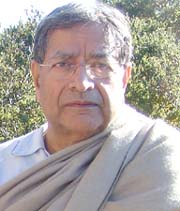 * Dr. S.N.Dhar is a renowned physician and has been practicing medicine in Srinagar for nearly five decades now. He retired as a Professor of Medicine at Medical College Srinagar where he was instrumental in setting up the department of chest diseases. Dr. Dhar is a well known academician and has published in national and international journals besides various book chapters on chest diseases. As a World Health Organization fellow, he has lectured at various medical institutions in USA .
These days he is actively involved in Human Resource development and is the spirit behind the establishment of Pundit Parmanand Research Institute involved in research in Kashmiri heritage. He has set up the love Kashmir society . He has been a avid sportsman, a trekking enthusiast, and has traveled widely. He is the author of 83 days and resides in RajBagh, Srinagar, Kashmir. | |
|
| |
| | |
| Copyrights © 2007 Shehjar online and KashmirGroup.com. Any content, including but not limited to text, software, music, sound, photographs, video, graphics or other material contained may not be modified, copied, reproduced, republished, uploaded, posted, or distributed in any form or context without written permission. Terms & Conditions. The views expressed are solely the author's and not necessarily the views of Shehjar or its owners. Content and posts from such authors are provided "AS IS", with no warranties, and confer no rights. The material and information provided iare for general information only and should not, in any respect, be relied on as professional advice. Neither Shehjar.kashmirgroup.com nor kashmirgroup.com represent or endorse the accuracy or reliability of any advice, opinion, statement, or other information displayed, uploaded, or distributed through the Service by any user, information provider or any other person or entity. You acknowledge that any reliance upon any such opinion, advice, statement, memorandum, or information shall be at your sole risk. |

 1 Mr MK Kaw’s suggestion that everybody should vote is not only timely but vital. He was a little apologetic, but I would be aggressive in this. In todays world while physical presence is important to assert a right , mere possession of even a small piece of paper can be of great importance. I hardly need to enumerate the great advantages that can accrue from this in the short term and certainly also in the long term.