Rudra Abhishekam
 |
|||
 |
|||
|
|||
 |
|||
|
Puja known as the Rudra Abhishekam was held at a Hindu Template, in Ft. Lauderdale Florida. This Puja is performed every first Monday of the month. Monday is considered a day dedicated to Lord Śiva. It is known as the Somavar in Sanskrit. The Puja was also dedicated toward receiving Śiva's blessings by offering abhishekam to the lingam, a symbol for the worship of Śiva. This lingam was to be used for devotional prayer by the wife of a couple who sponsored the Puja. Chau Nguyen – my wife and I were present along with others for this Puja. We were invited due to my previous work transliterating a devanagari copy of the Śri Rudraprasna during a Sanskrit 2 course in the Spring of 2007 at Florida International University. Something drew me to the Śri Rudra that generated enough motivation to learn to write devanagari through computer code and scribe it to my computer for my research use. The story and the concepts behind Rudra still fascinate me to this day as I continue to learn more and more of this Raudri Mantra.
The Śri Rudram Camakam is an important mantra in Vedic religion which is solely dedicated to Rudra, an early form of the God Śiva. The Śri Rudra is known by many forms such as Śri Rudraprasna, Śatarudrīya, and Rudradhyaya. The mantra enumerates the many names of the Deity with reference to the Śiva Purana.
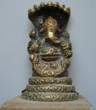
The devotee began the ceremony by invoking Ganesha. This was done by the Sanskrit prayer known as ganapati atharva śīrsa dedicated to the Vighna Harta for the removal of obstacles during the abishekam. The thousand names of Śiva are invoked to feel the presence of the divine one which is known as paramaśiva sadaśiva. The ceremony went on in this fashion, with the devotee chanting mantras and prayers by memory at a rapid pace. Before starting the main mantra, he declared the intent, time, place, and people of which was present for the Puja. This is known as Sankalpa which is loosely translated as mission statement. He asked everyone’s name and recited it within his chanting in order to invoke the deity on their behalf. He proclaimed tithi (Sanskrit lunar date), vara (the day), rashi (Zodiac sign), ritu (season), dik (place) and rashtra (country). He then chanted and paused occasionally to explain the mantra’s meanings to the devotees. Before he began chanting the Śri Rudraprasna, he paused to explain about the meaning of the first half of the mantra.
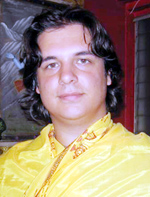
Abhishekam (water offerings) to the lingam was a long and involved process that included offerings of flowers, milk, ghee, honey, sugar, yogurt, and devotion toward the lingam. It was covered with the various consumable ingredients and then washed twice. The liquid that was washed off was collected in a patra (large bucket). The devotees took part in the Puja directly, being asked by the devotee to perform dīpa darshana (candle light offerings) ganda (incense offering), pushparcana (flower offerings) and naivideya (food offerings) to the lingam. The entire gathering was allowed to participating in anointing the lingam with milk. Everyone was given a tilakam on the forehead by Dr. Raina, considered a great pandit by the devotee, which was made out of sandalwood paste. All tried to chant alongside the devotee, but most were unable to do so. There were a few prayers such as the Guru Gita and Prarthana that some of the gathering knew from their Sunday worship ceremonies and were able to perform well. The entire ceremony lasted two and a half hours yet the devotee proclaimed he was rushed for time before the chanting of the 108 names of Rudra. It is interesting to note that the devotees who gathered to invoke the lingam seemed to be unaware of the ritualistic pattern. They were nervous, anxious and uncertain of each following step. The leading devotee, Śri Vijay Raghavan always seemed calm and composed like a teacher or an adult authority figure to which all others must pay respect to. It leads me to question the value of memorization of ancient texts toward the Hindu community. Dr. Raina mentioned that this was the only Puja that Śri Vijay Raghavan had memorized. Because of this the community gives great respect to Vijay Raghavan. It is, in reality quite a feat. The difference between Pujari and devotee is interesting to see, there seem to be parallels that can be made between a priest and the mass in Christian traditions. Even though everyone was much more involved and the community was much closer than at a catholic mass, the meaning of the language escaped almost everyone. The allegory and the power behind the mantra was lost in fantastical abstract deity worship. The part of the ceremony where everyone became truly involved was the chanting of the Bija mantra (seed syllable) Om aham aham aham Śivaya Namaha, and Om Namah Śivaya. This chanting was very musical in tune, and was spoken slowly in the svarit form of the Vedic meter until it culminated in an arousing crescendo, only to revert back to being spoken slowly to give it a svarit udatta form. This devotional form of emotional excitement is common across other religious traditions. Overall the experience was wonderful. I had never been to a Puja of this intensity. It was very intricate and well performed. I was offered and received prasadam even though they knew I was not of the Hindu faith. I was even invited and did participate in water oblations. There is much to contemplate about the meaning of the Mantras which I was presented with. There is also much to consider about the relationship between the advocates or authorities in religious traditions and the average devotee (laity). What is it that allows a human being to transcend the position of layman? What creates the desire and motivation to surpass his simple traditional and devotional views and enter into a complex world of ritual, symbol, and myth that conclusively inverts those views? Is the essence of the Mantra in its repetition or its analysis? It is possible that the essence of this mantra transcends both of these forms of practice and contemplation! On consulting with Dr. Raina, he suggests that it is pure communion where a devotee is charged what is known as shaktipata as described in the Utpalacharyas (Shaivistic Works). -Alexander David Conroy |
|||
|
|||
|
|
|||
|
|||
| Copyrights © 2007 Shehjar online and KashmirGroup.com. Any content, including but not limited to text, software, music, sound, photographs, video, graphics or other material contained may not be modified, copied, reproduced, republished, uploaded, posted, or distributed in any form or context without written permission. Terms & Conditions. | |||
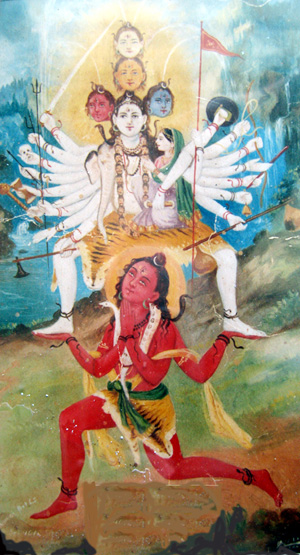

 I myself am a Roman Catholic by birth, but have since become somewhat of a pluralist when it comes to concepts of religion in my life. I am receiving training in an esoteric school which follows traditions and practices from all over the world, including Native American Shamanism, Jewish Kabbalah and Shaivite(Hindu) philosophy. I am also a Student and Professor of Religious Studies at Florida International University. My academic focus is on Mysticism and its comparison between religious traditions, specifically Judaism and Indian traditions. During my research at FIU, I strongly feel that there is relationship between Judaic symbols and monotheistic concept of the Trika school of Kashmir Shaivism.