Pull our common rope

|
| Let’s pull our common rope together
|
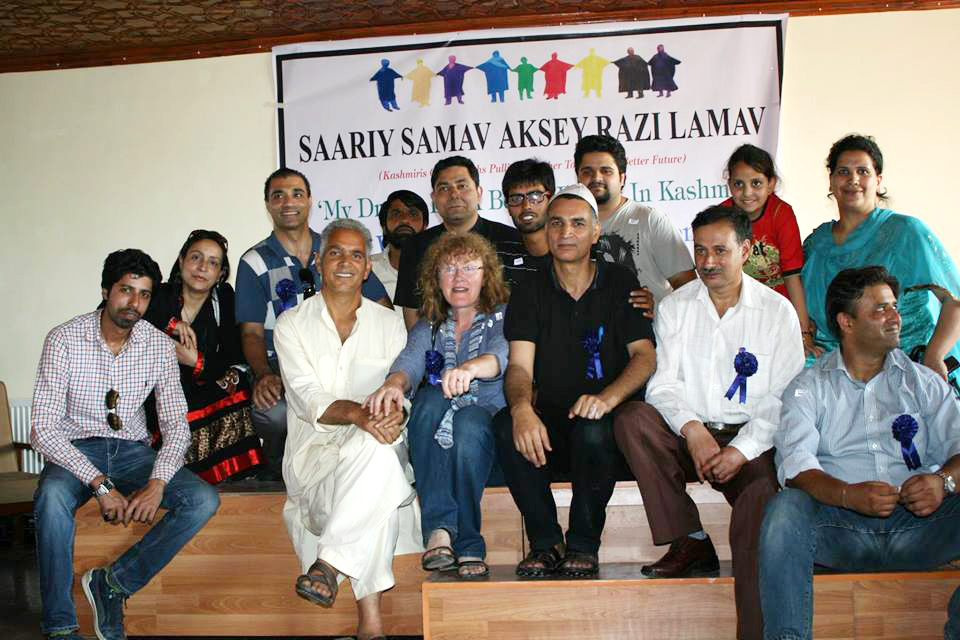
| It was the fateful year of 2010, when the Indian army killed two innocent villagers in Kashmir, where Vivek Raina along with Amir Jalali, a banker and his friend from Kashmir conceived the idea of SSARL. SSARL is a Facebook page to start a non-political reconciliation movement between Pandits and Muslims from Kashmir. Today, three years later, it beholds quite a few achievements in bringing the estranged communities of Kashmiri Muslims and Kashmiri Pandits together, after 25 years of mutual disregard. Named, ‘Saariy Samav Aksey Razi Lamav,’ (after a line from a verse by the Kashmiri mystic Lal Ded, which means, “Let us pull the common rope together”) it strives to create a culture of tolerance and harmonious co-existence. While there has been no dearth of contributors to the political discourse on Kashmir; individual interaction between the two most important parties in the conflict has remained elusive. For pundits like me knowing Kashmiri Muslims never went beyond the “Shawl wallahs” who would throng our houses selling some of the best quality Pashmina in the world and “Koshur Wazas” who would be the source of luscious taste of food in our marriages. So, thus in the year of turmoil in Kashmir, an idea turned from a reason of keyboard activism to a meeting point for Kashmiri Panditss and Muslims in Delhi’s historical Lodhi gardens in December 2010. To say people from both sides were apprehensive before the meeting would not be far from truth. People asked each other difficult questions and tempers were raised. However, here you would not find vested interests ruining the dialogue, so over Kashmiri kulcha and kehwa things started falling into place. Dialogue moved from the 90s to a few years back, individuals began to locate each other from Kashmir. Hence over cups of tea, personal bonds were formed and promises to meet again were delivered. The following year in April, SSARL went to Mishriwalla camp to encourage the Pandits to participate in the organization’s movement of bringing the estranged communities together by making them stay in each other’s homes for a couple of days. What came as a surprise was the fact that people had already been visiting Kashmir, especially people who had land and other immovable property in Kashmir. However, what remained elusive was the personal interaction and camaraderie. All through these years this fact remained widely unpublished and unreported in mainstream media. May be it contradicted with popular perception that Kashmir is dangerous place for non-Kashmiris to visit; thus feeding into the massively exploding Islamophobia in India especially post-Babri Masjid demolition. As I hear Vivek speak about this experience of talking to the camp dwellers my memory takes me back to my own experience of working with Pandit migrants in Jammu. I try to imagine how difficult would it be to ask these poor hapless Pandits, who have been the worst sufferers of the ethnic violence in Kashmir, to shed their anger, their bigoted opinions and claim their right on Kashmir. Vivek’s voice interrupts my reverie he says, “The chief motto of SSARL is to break jinxed narratives on Kashmir and make Pandits and Muslims to accept each other as equal claimants on their motherland.” My immediate question is, “How do you do that”? There comes a prompt reply, “By organizing visits of a 100 Pandit families to Kashmir and making them stay in Muslim households and vice-versa.” It raised my eye-brows, transgressing households between Kashmiris means crossing social and caste boundaries. Generations of apartheid and untouchability has remained and evolved between Pandits and Muslims with times. However, with every inch, Vivek, Amir and Gowhar move closer to their dream of bringing the neighbours closer together. Discussing the idea with Vivek he brings out an important fact that dialogue over Kashmir has been jinxed from all corners. He dreams of bringing ordinary Kashmiris to contribute to the changing dialogue in and out of Kashmir. “While the political problems in Kashmir stay where they are primarily because of the absence of the Govt. of India’s composite Kashmir policy, individual dialogue between Pandits and Muslims could not wait for invitation from any party or a convenient atmosphere,” believes Vivek. Political opinions are put across in meetings and vary extremely, however; the culture of tolerance remains embedded in the system of SSARL. In year 2012, SSARL came together to organize a drawing and writing event with Srinagar-based, Sanjay Tickoo of Kashmir Sangarsh Samiti. More than a thousand children participated from some of the most remote areas of Kashmir. In 2013, a “Zalgur” event brought enthusiastic cyclists together in Srinagar in summer as a drive to reclaim lost city sacred us. Combating religious extremism remains a cause of concern for lovers of, “Maej Kaeshir.” Bringing Pandits back to Kashmir is believed by majority in SSARL as an important step in that direction. So four meetings have been conducted so far, discussing the ways and means by which this dream could be turned into a reality. So, “what has been response?” I ask. “Over-whelming positive!” says Vivek. Haven’t we heard that before whom it was last time Yasin Malik or Syed Ali shah Geelani? Cynicism is not bad for human survival, in fact it is a primary tool used by humans to survive in travesty. Pandits have heard these pleas of return to Kashmir before. What remains to be seen is whether they would return to a Kashmir which remains economically backward. A Kashmir where basic medical facilities are non-existent in major hospitals and a Kashmir where the Grand mufti of the largest mosque in Srinagar declares an all-girl musical band, “Haraam” while himself enjoying “chaker” on the banks of Dal. Meanwhile, in the first time in history of Kashmir, post-90s Pandits acknowledge the violation of human rights in Kashmir by security forces openly and express solidarity with Muslim counterparts. Repealing of draconian laws like AFSPA finds consensus in meetings at SSARL. All this while, everyone in the core team of SSARL remain confident that this process of reconciliation will not die a political death. Not a bad begging at all! |

|
 *Born to Kashmiri Pandit parents in Jammu. Finished his schooling from, Army School Damana. Amit has deep rooted interests in Literature, Poetry and Kashmir's history and culture. He was recently invited as youth a Kashmiri leader to participate in a workshop by WISCOMP (Women In Conflict, Security Management and Peace, Workshop) Identity, Conflict, and Coexistence: A Conflict Transformation Workshop for Youth Leaders held on December 18-20, 2013 in New Delhi. Amit has been writing articles in the Kashmir Sentinel, in the youth space and is working towards sustenance of the Kashmiri language in the youth. A firm believer in equal rights for women, he conducted an Inter-University workshop, "Gender inequality with Women in Work places," in London, where people from London School of Economics, Greenwich University, Coventry University participated
 |
|
|
| Copyrights © 2007
Shehjar online
and
KashmirGroup.com
. Any content, including but not limited to text, software, music, sound, photographs, video, graphics or other material contained may not be modified, copied, reproduced, republished, uploaded, posted, or distributed in any form or context without written permission.
Terms & Conditions.
The views expressed are solely the author's and not necessarily the views of Shehjar or its owners. Content and posts from such authors are provided "AS IS", with no warranties, and confer no rights. The material and information provided iare for general information only and should not, in any respect, be relied on as professional advice. Neither Shehjar.kashmirgroup.com nor kashmirgroup.com represent or endorse the accuracy or reliability of any advice, opinion, statement, or other information displayed, uploaded, or distributed through the Service by any user, information provider or any other person or entity. You acknowledge that any reliance upon any such opinion, advice, statement, memorandum, or information shall be at your sole risk. |