Matrimonials - Share your dreams
 |
|||
|
SAFFRON VALLEY
OF MYSTIC SPLENDOUR *- Dr. Satish Ganjoo |
|||
|
The fascinating Valley of Kashmir, lying at an average altitude of 5200 feet above the mean sea level, is approximately eighty-four miles in length and about twenty-five miles in breadth. The geological evidences confirm the concept that Kashmir Valley was a vast mountain lake, called Satisar. The existing remnants of this vast dead-water lake are the beautiful water bodies of Wular, Dal, Anchar, Hokarsar, Khushalsar and others. The old name of Satisar was replaced by Kash+Mir, after the name of great saint, Kashyapa, who devoted himself to religious exercises to fight the water-demon (jalodbhava). However, some scholars believe that Kashmir was called so on account of the early settlement of a semetic tribe called Kash, who also founded the cities of Kash, Kashan and Kashghar. But this theory is yet to be substantiated by indisputable evidences.It is commonly believed that the present inhabitants of Kashmir are the descendants of the Aryan race, who immigrated from the south under the patronage of saint Kashyapa. In proto-historic times, the probable semitic tribes of Kashmir-Nagas, Pisacas and Yaksas; used to go to Tibet and Central Asia in summer and return to the Valley in winter to harass the Aryans who had settled there. It was Chandradeva, a descendant of Saint Kashyapa, who interposed and restored the rites of the Nila to resist these semitic tribes. This also reveals the close ties which existed between Kashmir and Central Asia from very ancient times. In fact the Central Asian landscape begins from Kashmir the immediate neighbours of Kashmir in Central Asia-Ladakh, Baltistan and Dardistan; were integral parts of Kashmir Mandala during all periods of history down to the year 1947, when the Dogra rule came to an end.The veritable chain of mountains which surround the Valley presents a magnificent and imposing view. To the north is great promontory of Naga Parbat, 26620 feet; and to the east stands grim Haramukh, 16903 feet. Further south is the sacred Mahadeo; followed by the lofty Gwash Brari, 17800 feet; and the mountain in whose bosom lies the sacred cave of Amarnath, 17321 feet. On the south-west is the Pirpanjal range, 15000 feet; further south is the Tos Maidan, 14000 feet; and the snowy Kaji Nag, 12125 feet. The mountains of Kashmir are infinitely varied in form and colour. The Valley is connected with the outer world by no fewer than eight mountain-passes.
Kashmir can claim the distinction of being the only region of India which possesses an uninterrupted series of written records of its history. The earlier known kings of the Valley are Gonanda I and Damodara I. According to Kalhana, Gonanda I was the contemporary of Kauravas and Pandavas (later Vedic period). Hasan Khuihami claims to have traced the thirty-five kings, which were missing in Kalhana’s chronicle. Of the early kings who ruled over Kashmir at the beginning of Christian era, Ashoka followed Buddhism; while his son, Jaloka, reverted to the worship of Lord Shiva. The Buddhists, however, regained their strength under the patronage of the Turushka kings-Hushka, Jushka and Kanishka. In spite of natural geographical impediments and high mountain ramparts, Kashmir had maintained close relations with the contiguous ruling principalities of Central Asia. Buddhist missionaries from Kashmir – then great centre of the Buddhism; extended their work beyond the Hindukush in Central Asian territories, China and Tibet. They bore the hazards of traversing the difficult routes for the propagation of the Buddhist philosophy in these distant lands. Most of the Buddhist missionaries who worked in Central Asia, China and Tibet hailed from Kashmir or had received their education and training in the Valley. Natural calamities took a heavy toll of life as these dedicated missionaries traveled over the fatal mountain tracks. The Buddhist scholars from Central Asia were also provided the schooling in Kashmir. During the reign of King Tunjina, an impending disaster of famine was averted by the miraculous arrival of countless pigeons. King Pravarasena II ruled over Kashmir from A.D. 79 to 139, and founded the capital city Srinagar. The wicked and cruel Mihirakula who ruled over Kashmir in A.D. 515, killed hundreds of elephants for his amusement. He also ordered the execution of thousands of women, for their supposed unchastity, along with their husbands and brothers. Kalhana has discussed in detail the eminent ruling dynasties of Kashmir – the Imperial Karkota, Varman and Lohara. Dulacha or Zulju, a Mongol from Turkistan, invaded Kashmir in A.D. 1320 and caused incredible tyranny, bloodshed and destruction to the people and land of Kashmir. With the founding of Sultanate in A.D. 1339, Kashmir became a land of attraction for the Muslim missionaries, Sufis, saints and divines of Central Asia, who came in great numbers and propagated the message of Islam in the region. The foreigners began to influx in the Valley and the territory established links with the neighbouring Muslim countries .Central Asian culture, customs, habits, usages, manners, dress, diet, language and ideas penetrated into this little Kingdom, which brought about a socio-cultural change in the contemporary society of Kashmir. In due course of time a new culture comprising indigenous and foreign elements came into being.The credit of islamising Kashmiri society goes to Central Asian saints, sufis, artisans and men of letters. Internal disorder and turmoil compounded with Timur’s invasion of Iran and other parts of Central Asia had compelled these people to leave their native land and move in search of a secure place. In doing so, they found shelter in Kashmir. At this point of time, Buddhism was being replaced by Saivism in the Valley. The Muslim missionaries found themselves face to face with the followers of Sivism. The outstanding immigrant saint, Sayyid Ali Hamadani, popularly known in Kashmir as Shah Hamadan, who planted the sapling of Islam in the Valley, was from Hamadan in Iran. Bulbul Shah – a well known Muslim missionary, and Shahmir – a refugee from Iran, manipulated the conversion of Rinchana – a Buddist, to Islam and laid the foundation of Muslim rule in Kashmir.Sultan Sikander—the Iconoclast, destroyed the grand and old temples in the Valley and used their plinths and friezes for raising mosques. Hindus were offered three choices-death, conversion and exile. Some of them fled Kashmir. many were executed and most of them were converted to Islam. About seven maunds of sacred threads of the massacred Brahamns are reported to have been burnt and the sacred books of Hinduism were thrown into Dal lake. 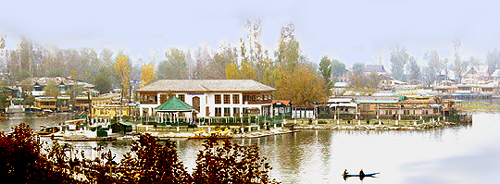 The saying goes that there virtually remained only eleven Brahman families in Kashmir, and Sikander, under the evil influence of Suh Bhat- the newly converted general, flattered himself that he had extirpated Hinduism from the Valley. The great King-Zain-ul Abidin’s chief glory was his tolerance towards his Hindu subjects. He manifested every desire to repair the wrongs inflicted on the Hindus by Sikander.The intellectuals and scholars from Iraq also found Kashmir as a fertile field for propagation of their faith. These scholars were encouraged and even provided jagirs in the Valley. Mir Shams-ud-Din Iraqi, who visited Kashmir twice, was the founder of Nurbakhshiya order in the Valley. His mission was to strengthen the roots of shia faith in Kashmir. But Mirza Haider Dughlat, who ruled over Kashmir from A.D. 1540 to 1551, was not favourably disposed towards Shiaism and sowed the seeds of discord between the two sects of Islam, Sunnis and Shias, only to further his political interests.With the advent and expansion of Islam in Kashmir, an interwoven Hindu-Muslim culture gradually began to emerge. Both communities influenced each other. The newly converted Muslims did not give up their old customs and traditions at once. The Hindu shrines and places of pilgrimage continued to be sacred for them. Even inter-marriages took place in the upper classes. The Muslim rulers married Hindu women and allowed them to profess their own religion. Hindus learnt Persian language and attainted respectable scholarship in that literature. However, Sanskrit remained confined |
|||
 |
|||
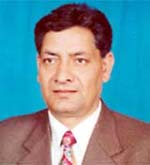 *- Dr. Satish Ganjoo was born on May 1, 1956, to Shri Omkarnath Ganjoo and Smt Sheela Ganjoo in the Saffron Valley of Kashmir. He obtained the coveted academic degrees of M.Phil (1983) and Ph.D (1987) in Modern History and International Relations from the University of Kashmir. He held the distinguished faculty positions in various colleges in Kashmir. Dr. Ganjoo developed the excellent potential for research and published a number of books on diverse topics of history, politics, international relations and Islamic studies. Besides Dr. Ganjoo was involved in different interdisciplinary research projects, participated in several seminars and wrote about sixteen research papers. Presently working as Senior Faculty Member at the Post Graduate Dept. of History, Ramgarhia College Phagwra (India), *- Dr. Satish Ganjoo was born on May 1, 1956, to Shri Omkarnath Ganjoo and Smt Sheela Ganjoo in the Saffron Valley of Kashmir. He obtained the coveted academic degrees of M.Phil (1983) and Ph.D (1987) in Modern History and International Relations from the University of Kashmir. He held the distinguished faculty positions in various colleges in Kashmir. Dr. Ganjoo developed the excellent potential for research and published a number of books on diverse topics of history, politics, international relations and Islamic studies. Besides Dr. Ganjoo was involved in different interdisciplinary research projects, participated in several seminars and wrote about sixteen research papers. Presently working as Senior Faculty Member at the Post Graduate Dept. of History, Ramgarhia College Phagwra (India),Books authored & edited Afghanistan's Struggle for Resurgence, Soviet Afghan Relations, Dictionary of History, Kashmir Politics, Muslim Freedom Fighters of India, 3 vols, Economic System in Islam, Prophet Muhammad, Glimpses of Islamic World & Wailing Shadows in Kashmir |
|||
|
|||
| Copyrights © 2007 Shehjar online and KashmirGroup.com. Any content, including but not limited to text, software, music, sound, photographs, video, graphics or other material contained may not be modified, copied, reproduced, republished, uploaded, posted, or distributed in any form or context without written permission. Terms & Conditions. | |||
|
|
