MORE AUTONOMY FOR ANARCHY?

| |||

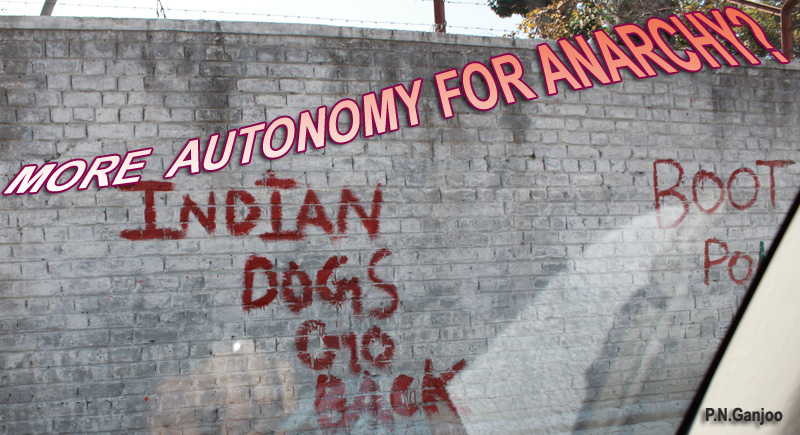
These signs on walls are a common sight in Srinagar Kashmir -Image by Nihar Ganju | |||
| Currently, it has become fashionable for academicians, journalists, bureaucrats and politicians to attribute all systemic and governance failures in the state of Jammu and Kashmir to New Delhi. But it is a jaundiced view to target New Delhi for all that ails and fails the state. All this is unfair and therefore unacceptable. The latest take on the present mess in Kashmir by Najeeb Jung, VC of Jamia Islamia University, Delhi, published in the Hindustan Times of 25th April 2011, though illuminating and path breaking, falls prey to propaganda and whispers of the separatists. He too assigns all causes and problems of Kashmir malady to New Delhi and its mandarins in politics, diplomacy and administration. Yet, at the same time, he has analyzed the Kashmir malady with sharp insight from the political and historical perspective. It is perhaps for the first time that a scholar of his status has spoken some plain but bitter truths regarding the present Kashmir muddle. This muddle is a creation to which many actors have contributed, while observers have either hesitated or sidelined comment.
He is sincere and candid to admit that Kashmir Muslims have done little (rather nothing) to regain confidence of their Hindu neighbors (Kashmiri Pandits) who were chased out of their homes by separatists, supported by Islamic fundamentalist militants trained and pushed by Pakistan into the valley. He rightly asks Kashmiri Muslims as to when they showed disapproval of the evolving conditions of Islamic fundamentalism which preached establishment of Nizami-Mustaffa in the valley? He asks as to how Kashmiri Muslims permitted mass migration of their Kashmiri Pandit neighbors with whom they had been living together in harmony for centuries, practicing similar culture and with similar ways of life and customs. He asks them if the Kashmiri Pandits were not going through the same troubles and trepidations during the period of militancy, through which Muslims of rest of the country went during the partition of the country in 1947. These, are all relevant questions which others have shied from responding to. Najeeb Jung rightly states that due to sustained machinations by Pakistan backed and sponsored terrorists and separatists, attempts are still made to prevent recovering the composite culture of the valley. He feels that the time has come for the Muslims to heal festering wounds and to nurse mauled sentiments by taking positive initiatives. He is right to remark that people of the valley are stuck between self seeking politicians, Indian forces, haunting shadows of Pakistan backed terrorists and arrogant separatists. However, one can hardly agree with him that after Sheikh Abdullah, a series of complications happened in Kashmir which aggravated matters. This, he feels has given birth to a generation of children of militancy imbued with hopelessness and despondency. He is right to state that Pakistan will continue to remain our undependable neighbor, with whom we have to learn to live despite all irritations; yet on our own terms. So he advises that we shall have to seek a solution to the Kashmir problem independent of Pakistan and its machinations. Does he need to be told that there is no Kashmir problem without Pakistan interfering? If Pakistan is dissuaded to keep out of Kashmir, the issue will settle itself within the democratic framework of the Constitution of India and Constitution of the state that grants a special status to the state. He has further pleaded for revitalization of Article 370 as a confidence booster. Does he need to be told that Article 370, granting special status to the state in the Indian Union, has neither been tampered nor eroded by the Union of India? All amendments and modifications to it were pleaded and initiated by the state governments from time to time, which were necessitated by new demands and change of times. All these amendments were formulated under due process of democratic law making? It is simply not correct to assume that all such moves of change and modifications were initiated and prompted by the government of India. In fact such amendments and modifications were made by the state legislature, which is the supreme law making body of the state. Amendments were made only with the view to extend fruits and gains of democracy, development and technology to the state and ensure equal progress with rest of the country. He further advocates revocation of Armed Forces Special Powers Act from the state, which is however only a temporary power granted to the security forces to handle seditious and insurgent conditions. Those were created by Pakistani sponsored terrorists and their cohort separatists. These special powers are invoked only by state government to empower security forces for search and arrest in order to maintain peace and order in such parts where law and order is disrupted by the separatists. This power can be revoked simply by an executive order once conditions in the valley are normalized. Jung’s suggestion to institute a Truth and Reconciliation Commission to go into the causes of civil turmoil in the valley is a cogent proposal if it covers all aspects and dimensions of Pakistan sponsored militancy and interference in the state since 1947. It should also consider all regional and religious imbalances and discriminations perpetrated in the state by Kashmir centric politicians of the valley. It has also to go into the reasons of targeted massacre and pressure for mass migration of nearly half a million Kashmiri Pandits at the beginning of militancy in 1989-90. It has to go into the reasons of gradual denial and discrimination against Kashmiri Pandits perpetrated since 1947. It has also to go into the reasons of discrimination against people of Jammu and Ladakh by Kashmiri Muslims who monopolized politics, administration and development of the state since 1947. Such a move can well assuage hurt feelings and bruised sentiments of all people of the state through democratic use of Indian system of justice and fair play. No one can disagree with Jung that both public and private sector should open their gates for Kashmiri youth to participate in the Great India Growth Story in larger numbers. In this respect it is to be stated that all government and public sector jobs in the valley are virtually reserved for Muslim youth of the valley who occupy them without any hindrance. And regarding private sector employment, the valley has yet to open and embrace Indian Industry. Indian industrialists are reluctant to open their shop in the valley in the face of so many laws and rules and hurdles. The Law of State Subjects which bars all other Indians, excepting people of the state to buy land in the state bars Indian industrialists to establish businesses in the valley. Unless such irrational hurdles are removed, no break through can be achieved. But this is simply not possible if more autonomy is dished to the valley. When he suggests more autonomy to Kashmir within the framework of the Constitution, he does not explain the details of the suggestions. He has to balance this proposal with the demands of both Jammu and Ladakh divisions which are opposed to all such moves of more autonomy. Instead they are indeed interested in more and more provincial autonomy to wrest away from the stranglehold of Kashmir centric monopoly. Besides the existing quantum of autonomy has already insulated the state from rest of the country which has in effect affected its industrial and services sector growth adversely and made it a state of shortages. At present the state enjoys sufficient autonomy in terms of law making, even on concurrent list and extension of central laws and orders to the state. The state has its own Constitution which is recognized and respected by the Constitution of India. The state has its own flag and has a unique personality as compared to other states. It has a State Subjects Law on the statuette which bars outsiders to seek employment in the government and own land in the state. The state has already passed and executed Agrarian Land Reforms Act some six decades back by which it has granted ownership rights to tenants without compensation (a radical move even at this time which no other state in India has ever ventured to do).What kind of more autonomy is Jung thinking of, could he please elaborate? Does he need to be told that Kahmiris have all along been governing themselves since 1947 and continue to do the same? It is simplistic to think that they do not want to be ruled by New Delhi. At no point of time was the state ever ruled by New Delhi direct or by proxy excepting two short spells of Governor’s rule when there was a constitutional breakdown. Further it will be pertinent to state that all Chief Ministers since 1947 were elected by the democratic process of elections based on adult franchise in which Muslims of the valley too participated in large numbers. In such elections of the Chief Ministers only Kashmiri Muslims came to power excepting once when a Muslim from Jammu division was elected for a short span of three years. So it is not correct that all CMs of the state were installed by New Delhi as their cronies. Stalwarts like Sheikh Abdullah, Bakshi Gulam Mohd, Gulam Mohd Sadiq, Sayeed Mir Qasim and Dr. Farooq Abdullah were elected CMs of the state from time to time. People of the state have been participating in regular elections with zest and have been electing their representatives by due democratic process in the face of calls of boycott and threats by the terrorists. In the latest instance 80% people of the valley voted in Panchayat elections to elect their representatives for local self governance despite calls of boycott and threats of the terrorists, who even killed two candidates for participation. This election is the final verdict of people of Kashmir against violence, hate and turmoil. It is simply not fair to allege that all elections in the state were rigged though some may have been in part. But elections in the state have been only as fair or unfair as in other states of the country, conducted under the eagle eye of the fair Election Commission of India. Jung’s view that Kashmiri Muslims do not wish to be with Pakistan after seeing the mess it is sinking itself in may be correct. When he suggests that New Delhi should start talks with all stakeholders to resolve the Kashmir muddle, he needs to be clear as to who are these stakeholders in Kashmir polity. Should we assume these are only the handful of separatists and their Pakistan backed terrorists? Are other segments that comprise the bulk of the population of the state to be ignored because they believe in peace and democracy? The role needs to be made clear as to that of mainline political parties like National Congress, BJP, National Conference, PDP, Panthers Party, Communist Party of India and other vocal political segments of the state like Dogras of Jammu, Kashmiri Pandits of the valley, Shia Muslims of valley, Buddhists of Ladakh, Dards of Gurez, Pahadis of the borders, Gujars and Bakarwals of the hills and refugees of 1947 who desire deeper integration with the Union. Placating and succumbing to the blackmail of separatists and terrorists is not the best of the options for the Central Government. The Government has to come clean on all these crucial issues, which are more important than winning back heartless separatists who have always resisted and desisted a peaceful solution of problem. Any sane Indian will appreciate the anxiety of well-wishers of the nation for restoration of normalcy and peace in the state. But the question is peace at what cost? | |||
|
| |||
|
Presently he is working on his varied interests besides being a consulting Director of a software services company. | |||
|
| |||
| Copyrights © 2007
Shehjar online
and
KashmirGroup.com
. Any content, including but not limited to text, software, music, sound, photographs, video, graphics or other material contained may not be modified, copied, reproduced, republished, uploaded, posted, or distributed in any form or context without written permission.
Terms & Conditions.
The views expressed are solely the author's and not necessarily the views of Shehjar or its owners. Content and posts from such authors are provided "AS IS", with no warranties, and confer no rights. The material and information provided iare for general information only and should not, in any respect, be relied on as professional advice. Neither Shehjar.kashmirgroup.com nor kashmirgroup.com represent or endorse the accuracy or reliability of any advice, opinion, statement, or other information displayed, uploaded, or distributed through the Service by any user, information provider or any other person or entity. You acknowledge that any reliance upon any such opinion, advice, statement, memorandum, or information shall be at your sole risk. | |||
 *P.N.Ganjoo was born in a modest Kashmiri family about 7 decades ago, lost his father early and was raised by his honest, hardworking mother. With her efforts he received his education in Srinagar and went on to serve in various Government Departments before retiring as a senior grade KAS officer.