 ince time immemorial, Art has been understood to be the savior of mankind from all the afflictions of life. It completed the vacant spots of an individual with rich and soulful beauty.To be precise, Art is the expression of human skills and imaginations, which can create an object that is aesthetic in nature and pleases the sentiments of common people as well as satisfies the thirst of intellectuals.Money! Money! Money! Today the whole world is running after this demon of avarice. ince time immemorial, Art has been understood to be the savior of mankind from all the afflictions of life. It completed the vacant spots of an individual with rich and soulful beauty.To be precise, Art is the expression of human skills and imaginations, which can create an object that is aesthetic in nature and pleases the sentiments of common people as well as satisfies the thirst of intellectuals.Money! Money! Money! Today the whole world is running after this demon of avarice.
The greed for money never dies pushing even reputed renowned and sophisticated artists to go head crazy after commercializing their art piece, but the thing that fades with time and eventually dies is real talent. People commercialize their works with the sole aim of making fabulous amount of money. But behind the heaps of money that they make, there's a grave issue that needs to be highlighted. This issue is of the death of real talent.
Is it possible that we can actually live in a world where people see and think for themselves?
I, who have been an avid admirer of the arts and of the freedom do believe that commercialization, heavy promotion, marketing etc is a threat to the real talent of artists. Marketing, commercialization, replication through posters and images, as well as religious leanings have biased the perception of art in the world today.
How many millions of dollars have been made by replicating the Mona Lisa or Frescos from the Sistine Chapel. Angels, demons, Gods, Serpents, and other religious Catholic "images" are famous the world over. How long will it take before the other religions with "graven images" (not associated with the Church) get an understanding of the art to be made and decide to promote their "artists" on a mass scale. For shame..... You can NOT buy and sell God.
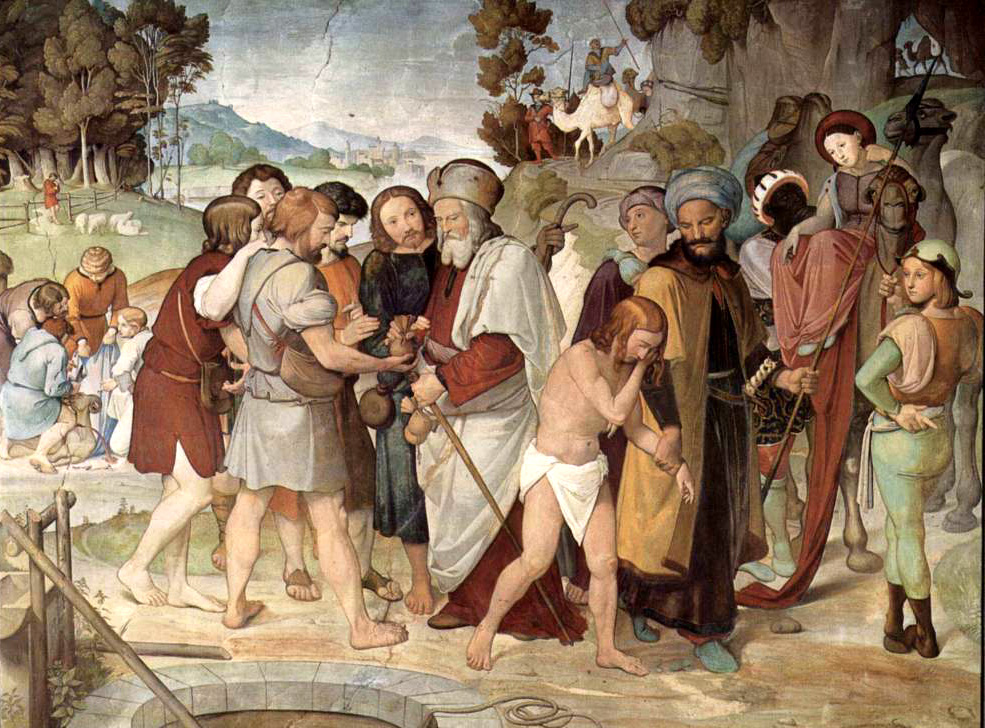
Frescos of Casa Bartholdy in RomSzene: The Selling of Joseph
It is indeed a disgraceful opinion to relate art with money. But, as the bitter nature of truth stands today, Art is getting commercialized and is leading to the death of authentic talent.There were times when artists like Leonardo Da Vinci and Michelangelo walked on our planet. They were not seeking capital from their respective works, but rather a sense of self-satisfaction and self-fulfillment.
 The most talked about work of art, Mona Lisa was completed by Leonardo Da Vinci in a span varying from 4 to 7 years. Is it possible that such a glorious depiction of artistry would have been actualized from the hands of a person seeking glory and money? Let's make it more explicit by an example. A young guy in his early twenties becomes curious about the world of the arts. He decides to do what others would do in these circumstances: he picks up a few art magazines from a local newsstand and browses their content looking for the latest trends. However, he increasingly becomes frustrated with the amount of advertisements that fill these magazines that appear to prevail over any sustained discussion on the arts. He dislikes the way art looks more like a big commercial circus than the honest display of creative talent. He grows disaffected with the patronizing tones of editors and so-called authorities in the field. The most talked about work of art, Mona Lisa was completed by Leonardo Da Vinci in a span varying from 4 to 7 years. Is it possible that such a glorious depiction of artistry would have been actualized from the hands of a person seeking glory and money? Let's make it more explicit by an example. A young guy in his early twenties becomes curious about the world of the arts. He decides to do what others would do in these circumstances: he picks up a few art magazines from a local newsstand and browses their content looking for the latest trends. However, he increasingly becomes frustrated with the amount of advertisements that fill these magazines that appear to prevail over any sustained discussion on the arts. He dislikes the way art looks more like a big commercial circus than the honest display of creative talent. He grows disaffected with the patronizing tones of editors and so-called authorities in the field.
In my opinion, possession of real talent blinds the greed and the notion of commercialization in one's eyes.It is due to the capitalist phenomenon, that there is a dearth of raw and pure talent amongst us. The excess of commercialization has resulted into the demise of imagination and ingenuity among the young minds. The enormous power that art possess has gone beyond one's conception. Commercialization will only erode its roots and will destroy the flair of a burning mind.
Art throughout the centuries has been used as a tool to communicate ideas, ideals, beliefs, and much more. Some would argue, perhaps that this has always been the function of art: to promote, to sell, to convince and persuade its audience in a propagandistic manner for a higher goal or purpose.
A quote comes back to me, loosely paraphrased, that an artist employs the use of lies in order to tell the truth. Art is used as a tool in advertising to control the public.
I believe that we have the ability to enact change most forcefully as consumer of the global products. Anything that makes money will continue to be made or sought after, but having knowledge of what products best serve us in terms of sustainability and availability would be beneficial.However, our spheres of knowledge are continually reduced or manipulated by advertising mechanisms on a constant basis, everyday, thousands of images, commercials, and ads that bombard our senses, which leads me to believe that we quite clearly live in a type of dystopian environment.
The commercial world aims to limit the knowledge of other alternatives besides their product. Advertising and commercials use art to create a world of abstraction and homogeny.
I understand that the first step would be to assess what I personally think is the purpose of art.Commercials employ art as a tool, but art is not necessarily a commercial.
As Oscar Wilde quoted, "Art is the most intense mode of individualism that the world has known", we all should remind ourselves the admiration we gather for real talent and thus should not let this individualism burn into commercialization.
Commercialization of art is within the framework of time, and situation. It is borrowed and not original. Real talent is the passion of the soul in a human being. What can one call sacrificing his inner talent at the cost of commercializing something other than mere foolishness?
This scenario has reached such an extent that today even the poorest of the poor artist does not hesitate in commercializing his art and then bringing it to the market. The outcome is that ultimately the poor fellow ends up earning a few bucks but bringing up the rear of
his own original talent.
What was the need of this? is there a reason that can explain 'why' on an individual level? There certainly it is .there is a difference of understanding, jolting, clarifying picture that shows us a glimpse of the human heart and his pressing desire to earn.But who says money can't be made
without commercializing your piece of art , by letting it be quite original your very own.

Today we witness a commercialization of art in the Western society. Many famous artists create art in factory like studios. Often their art become expensive commodities and fetish objects for superrich, who use art only as status symbols to demonstrate their power and wealth in a similar way as expensive cars and yachts. Although most contemporary artists do not create art for this purpose, a growing number of artists seem to be seduced by the money value of art and contribute with little hesitation to the commercialization of art. From the perspective of art, this is problematic, because in a long term it may waive the art's autonomy. Many artists are also supported economically by corporations or private collectors who become patrons, a practice that diverge from country to country, but where the economic power, rather than artists may dictate the development of art.
The core concept of greed has blackened out the inventiveness and freshness of Art. It never was a business and should never be treated to be a pursuit of extracting revenues.So the next time you go for something to adorn the walls of your homes,. I suggest: "Choose carefully and don't go for the highly commercialized paintings that the general crowd is buying. Instead search out for a talented
exclusive piece of art".
Question yourself -which one is better? I am sure in the next breadth only you'll get an answer to it. Delna Dastur a member at the Smithsonian Institution in Washington, DC and the Art League of Alexandria pushes students to think beyond traditional definitions of art, saying, "Don't try to make beautiful paintings by commercializing them .Give your best by doing your bit and then let your talent speak out let your art define your work'' Lets make it more explicit by an example…………..
Of Salma Arastu who makes paintings with the sole aim of enjoying and conveying a message through it. She does not mind at all if her paintaings remain unsold for months or year's because she derieves pleasure from art, and she strongly opposes commercialization.

|



 *Vibhasa is a 10th grade student of Sophia Senior Secondary School,Ajmer. She has interest in dance, debates, acting etc. Her extempore speeche on "Save the Water Resources" was greatly appreciated. She acted as Bhagat Singh, acted in a play on Mahatma Gandhi enacted on Gandhi Jayanti. She is a good orator, and has recited Hindi poems for Shehjar. She is proud of her Kashmiri heritage